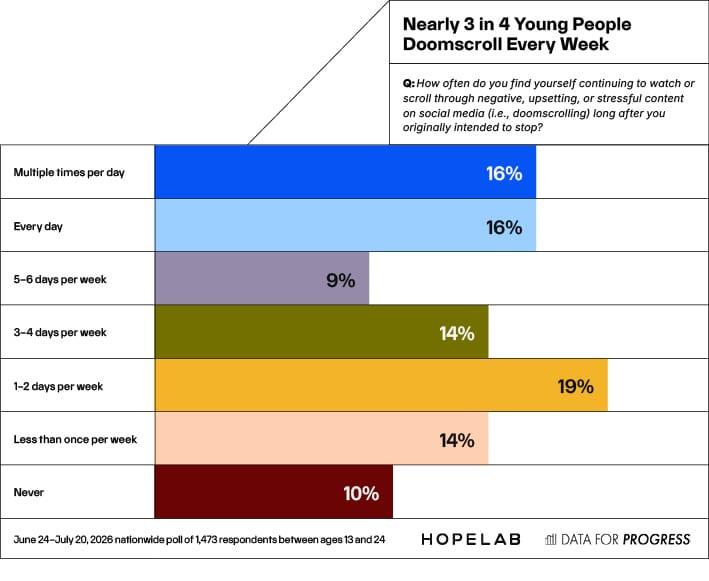
88% of young people engage in doomscrolling and about half say the habit costs them more than an hour of sleep on the nights they engage with negative or upsetting content online.
This national poll from Hopelab and Data for Progress, examines the impact of doomscrolling — continuing to watch or scroll through negative, upsetting, or stressful content on social media long after intending to stop — among young people aged 13 to 24. The poll explores how the habit affects sleep, mood, and young people’s sense of being informed and motivated to act, and identifies when and where young people doomscroll most.
Meta’s recent child safety settlement with 47 states, the District of Columbia, and several U.S. territories requires overnight curfews, school-hour notification limits, and daily time caps for teens on Instagram and Facebook, putting a spotlight on how platform design shapes young people’s nighttime habits.


Doomscrolling negative or upsetting content is most frequent during free time or before bed, with around two-thirds of young people reporting doing so at these times over the last two weeks. About half of those surveyed state that doomscrolling costs them more than an hour of sleep on the nights they doomscroll, with another 25% losing 30 to 60 minutes, and 18% losing 15 to 30 minutes.
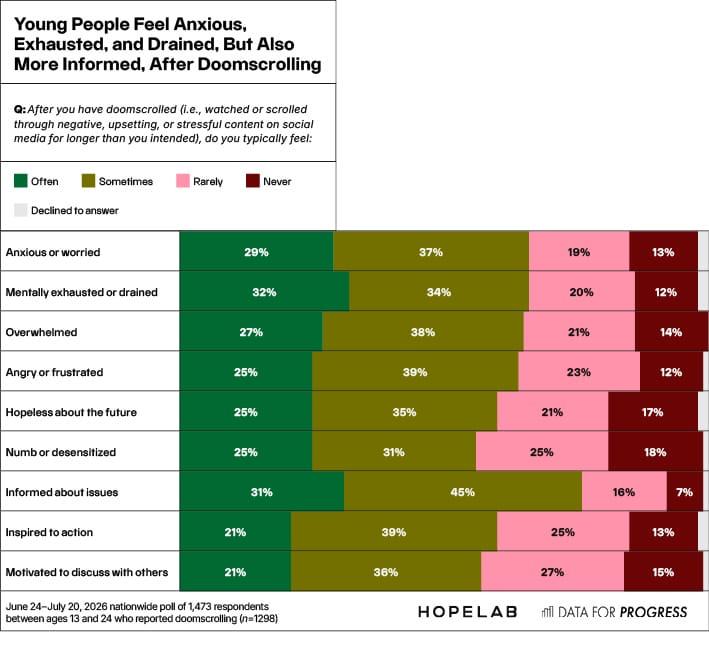
Six in 10 young people say doomscrolling negative or upsetting material makes them feel anxious, mentally exhausted, overwhelmed, angry, or hopeless. Yet 76% say it helps them stay informed about issues — the most commonly reported effect — and 60% say it inspires them to take action, such as advocating, changing their behavior, or donating.
Negative doomscrolling is more than an individual habit; it is a structural challenge. Platforms are designed to capture and hold attention, especially for emotionally charged and negative content. The endless-scroll design built into digital platforms makes it difficult for young people to stay informed on local, national, and international issues without also being drawn into negative doomscrolling.
This research highlights a clear challenge: young people need ways to access timely, meaningful information without sacrificing their rest, well-being, or sense of hope.
At the systems and policy level, there is a need for social media companies to build products and platforms with the well-being of young people in mind, including measures to reduce compulsive use of these platforms. Design practices that discourage behaviors such as doomscrolling should be implemented on platforms. These include eliminating personalized algorithms or implementing features that limit young people’s screen time on social media, especially at night.
Though doomscrolling is a systemic issue, individual interventions can still be valuable for users to reduce negative effects on well-being. Strategies include learning mindfulness practices to increase self-awareness and promote self-efficacy in managing mobile device time, using apps that delay or block the opening of specific apps to disrupt compulsive use, and reading fiction with generally positive themes.
While algorithms are designed to keep young people scrolling online for long periods, they should be encouraged to engage in more in-person leisure activities. For example, regular exercise can promote disengagement from screen time and improve physical and mental well-being. Communities may develop third spaces for young people that serve as venues for interaction and activity, rather than relying solely on online connections.
Young people should have an equal stake in the decisions made around the design and development of the online platforms they use. Whether by working with policymakers, social media companies, or other industry leaders, young people should be provided with meaningful opportunities to co-design online platforms with their needs at the forefront. Efforts should go beyond simply collecting young people’s input to meaningfully implementing it in these products.